



Artificial intelligence can generate a month’s worth of captions before the first coffee break. It can sort customer data, suggest audiences, create image variations and summarise campaign results at a speed no human team can match. But speed is not the same as insight, and more content does not automatically mean better marketing.
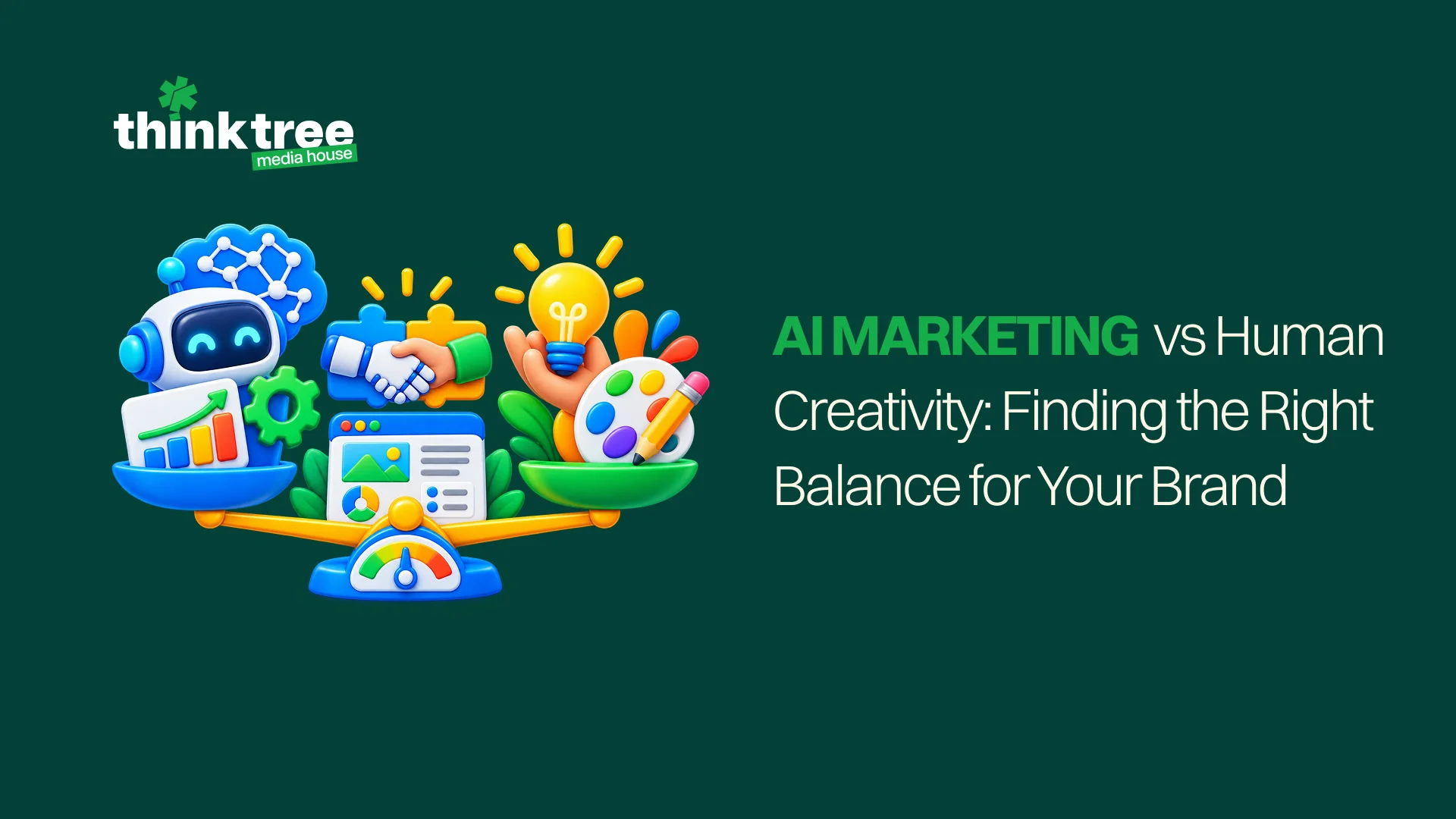
This is where AI marketing needs human creativity. Technology can extend a team’s capacity, while people provide the judgement, empathy and taste that make a brand recognisable. The real opportunity is not to choose one over the other. It is to decide which parts of the work should be automated, which should remain human-led and where the two can improve each other.
What Does AI Actually Do in Marketing?
AI refers to systems that identify patterns, make predictions or generate outputs from data. In marketing, those systems may recommend products, group customers, adjust media bids, draft copy, produce visual options or detect changes in performance.
The role of AI in digital marketing usually falls into three broad areas:
- Analysis: finding patterns in large sets of campaign, customer or website data
- Automation: completing repeatable tasks such as reporting, tagging or creating variations
- Generation: producing a first version of text, imagery, video, audio or ideas from instructions
These capabilities can save time and help a team explore more possibilities. They do not independently understand why a customer is worried, why a joke works in one city but falls flat in another, or why a technically correct campaign still feels wrong for the brand.
Where AI Adds Genuine Value
The strongest use cases begin with a defined business problem. Instead of asking, “Where can we add AI?”, ask, “Where is the team losing time, missing patterns or struggling to personalise at scale?”
Making Large Amounts of Data Usable
Marketers often have more data than time. AI can organise search terms, customer feedback, sales records and campaign results into patterns that are easier to review. It may reveal a recurring complaint, an emerging audience or a product benefit that customers mention more often than the brand does.
The machine can highlight the pattern, but a person still needs to decide whether it is important, why it is happening and what the business should do next.
Creating Useful Starting Points
AI marketing tools can help teams move past a blank page by suggesting angles, outlines, headline options or visual directions. They are also useful for turning an approved idea into different sizes, formats and versions for multiple channels.
This is especially valuable during production. A creative team can spend more time developing the central idea while software handles repetitive adaptations. The important distinction is that AI is extending an idea that people have shaped, not being asked to invent the entire brand position from a one-line prompt.
Improving Relevance at Scale
Different customers need different information. A first-time visitor may need education, while a returning customer may respond to a product comparison or timely offer. AI powered digital marketing can help select content, recommendations or messages based on behaviour and context.
Personalisation should still feel helpful rather than invasive. Use data that the business is permitted to use, explain important choices and avoid making sensitive assumptions about people. Relevance builds trust only when the customer feels respected.
Supporting Faster Campaign Decisions
Advertising platforms can process signals and adjust delivery much faster than a team working through spreadsheets. Google’s AI Essentials for advertising recommends starting with clear business goals and supplying high-quality creative inputs. That is a useful reminder: automation needs direction and strong material before it can produce useful business outcomes.
What Human Creativity Contributes
If AI is good at finding and reproducing patterns, people are needed to question those patterns, make unexpected connections and decide what is worth saying.
A Point of View
A brand becomes memorable by seeing the category in a particular way. That point of view may come from the founder’s conviction, customer tension, cultural insight or an experience competitors have overlooked. It cannot be reduced to a list of popular phrases.
Human strategists decide what the brand stands for, whom it wants to matter to and what it should refuse to sound like. This direction gives every later output a standard to meet.
Cultural and Emotional Judgement
Language carries history, humour and local meaning. A line that appears harmless in isolation may feel insensitive in context. A festive campaign may look polished but miss what the occasion means to the people celebrating it.
Creative teams notice these details because they live within culture, speak to customers and understand the circumstances surrounding the brief. That sensitivity is particularly important in a diverse market such as India, where language, humour and buying behaviour can shift significantly across regions and communities.
Taste and Originality
Generation systems are very good at producing something plausible. Brands, however, are rarely remembered for being merely plausible. They need choices: the unexpected visual, the line that creates tension, the pause in a film or the decision to say less when every competitor is shouting.
Taste is the ability to recognise which option deserves to exist. It comes from experience, references, curiosity and debate. Technology may widen the field of possibilities, but people still choose the direction that feels fresh and true.
Responsibility
The final campaign belongs to the brand, not the software. People must check claims, sources, permissions, representation, customer data and possible harm before anything is published.
NIST’s Generative AI risk-management profile encourages organisations to build trustworthiness into the design, use and evaluation of AI systems. For a marketing team, that translates into clear ownership, documented checks and a human who is accountable for the final decision.
How Generative AI in Marketing Changes the Creative Process
Generative AI creates new material from instructions and examples. It can produce text, images, audio, video and other content, which makes it particularly attractive to teams working against tight schedules.
Used well, generative AI in marketing can make the creative process broader and faster. A team can explore ten visual territories before investing in production, adapt approved copy for several audiences or turn a long interview into draft assets for different platforms.
Used carelessly, it creates a different problem: large volumes of generic work. When every brand uses similar prompts, formats and reference styles, their output begins to blend together. The production becomes more efficient while the identity becomes less distinct.
The solution is to keep the human idea at the centre. Build the concept first, provide the system with approved brand context, then edit the output until it has a clear reason to come from this brand rather than any brand.
A Practical Human-and-AI Workflow
The right balance becomes easier when the team agrees on a process rather than making a fresh judgement for every task.
1. Define the Problem and Outcome
Begin with the customer, commercial objective and channel. Are you trying to improve qualified leads, introduce a new category, retain customers or make campaign production more efficient? A clear outcome helps the team choose appropriate technology and evaluate whether it worked.
2. Decide What AI May and May Not Do
Create simple boundaries based on risk. AI may be allowed to summarise research, produce internal drafts and suggest variations. Claims, sensitive communications, final creative and customer-facing advice may require expert review.
The rules should reflect the business. A playful social post and a financial-services advertisement do not carry the same consequences, so they should not share the same approval process.
3. Supply Better Inputs
Weak instructions produce predictable output. Give the system an approved brief, audience context, brand voice, product facts, words to avoid and examples of good work. Remove confidential or personal information unless the organisation has explicitly approved the tool and use case.
Even the best AI marketing tools cannot repair an unresolved strategy. If the team cannot agree on the promise or audience, automation will only reproduce that confusion faster.
4. Add Human Review at Important Points
Do not wait until the final file to involve the creative and brand teams. Review the concept, a representative draft and the finished campaign. Check facts, tone, originality, accessibility, permissions and how the work may be understood outside the meeting room.
For high-risk or high-visibility work, involve subject specialists and people who understand the audience being represented. A review stage should improve the work, not function as a rubber stamp.
5. Test the Result, Not the Novelty
A campaign is not successful simply because it uses new technology. Compare it with a suitable baseline and measure the outcome that matters: qualified leads, purchases, retention, brand recall, production time or cost.
This turns marketing innovation into a business discipline. A clever experiment earns continued investment when it improves the customer experience or team performance, not when it merely makes an impressive presentation slide.
Common Mistakes Brands Should Avoid
Publishing the First Output
AI-generated work often sounds confident even when it is vague or incorrect. Treat every output as material to evaluate, not finished copy. Verify facts and rewrite sentences that do not sound natural for the brand or audience.
Confusing Volume with Consistency
Producing more posts can increase activity without strengthening memory or demand. A useful content strategy should still decide which topics deserve attention, how they connect and what action each piece supports. AI can assist production, but it should not turn the calendar into a content landfill.
Letting Efficiency Flatten the Brand
When teams optimise every message towards what performed before, they may remove the surprise that makes creative work memorable. Performance data should inform the next idea without becoming a fence around it.
Ignoring Privacy, Ownership and Bias
Before adopting a platform, understand how it stores prompts and outputs, whether submitted material may be used for training and what rights apply to generated assets. Teams should also check for stereotypes, excluded groups and false claims. This is essential when AI in digital marketing influences targeting, personalisation or public-facing content.
Automating Sensitive Conversations
Customers do not want a cheerful automated reply when they are reporting harm, loss or a serious service failure. Use automation to route and organise the issue, then give a trained person enough context and authority to respond properly.
Choosing Tools Without Chasing Every Trend
New platforms appear constantly, each promising faster content and better results. Instead of collecting subscriptions, assess the job to be done.
Ask:
- Does the tool solve a repeated and meaningful problem?
- Can it work with the team’s approved data and brand guidance?
- Are its privacy, security and usage terms acceptable?
- Can people review, edit or override its output?
- Does it integrate with the current workflow?
- Can the business measure the value it creates?
A small, well-governed toolset is usually more useful than a crowded stack nobody fully understands. Think Tree’s AI services can help brands identify suitable use cases and integrate them into practical marketing workflows.
Measure Brand and Performance Together
The speed of AI powered digital marketing makes short-term measures easy to track. Cost per click, lead volume and production time are important, but they do not tell the whole story.
Also look at lead quality, repeat purchases, customer sentiment, branded search, message recall and whether people can correctly describe what makes the brand different. A campaign that produces cheap attention while weakening trust is not efficient in any meaningful sense.
This balanced scorecard keeps experimentation connected to brand building. Think Tree’s performance marketing services combine campaign execution with measurement, while its branding and graphic design services help establish the identity those campaigns need to protect.
The Future of Marketing Is Human-Directed
The debate is often framed as machine efficiency versus human imagination. In practice, the strongest teams will combine both. They will automate repetitive work, use data more intelligently and create more room for research, thinking and craft.
The future of marketing will therefore depend less on whether a brand uses AI and more on how thoughtfully it uses it. Technology will continue to change. A clear position, customer empathy, original ideas and accountable decisions will remain valuable because they give the technology somewhere meaningful to go.
The best approach to AI marketing is not hands-off automation or resistance to every new tool. It is a considered partnership: people set the ambition and standards, technology expands what is possible, and people decide what is ready to represent the brand.
At Think Tree Media, we bring strategy, creative thinking, production and technology together so that innovation serves the idea rather than replacing it. If you want to explore marketing innovation without losing the voice that makes your business distinct, talk to our team about building a responsible AI powered digital marketing approach.
