



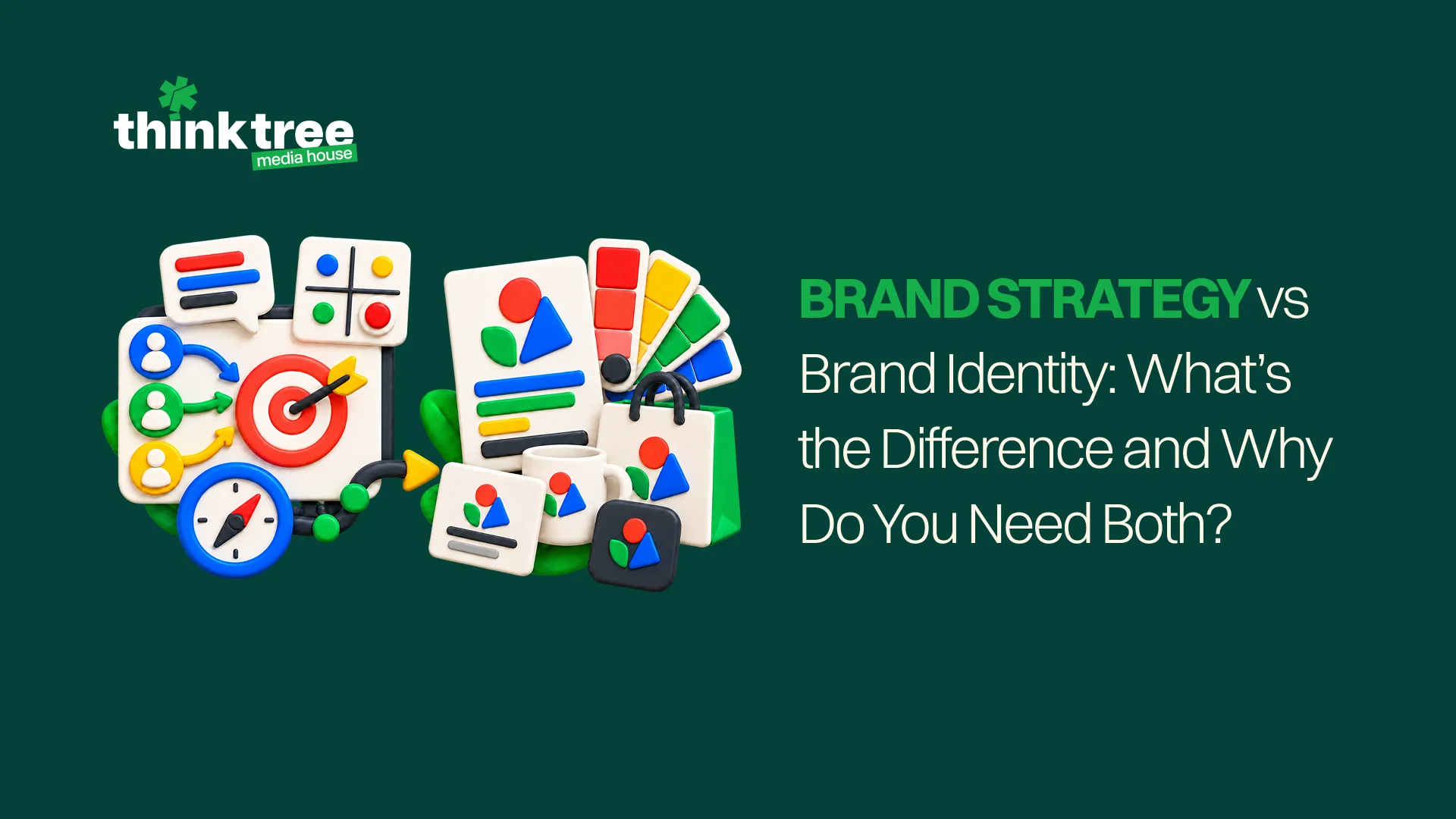
A brand can look stunning and still leave people unsure about what it stands for. It can also have a clever business plan and a clear audience can also have a clever business plan and a clear audience, yet appear as though its logo, packaging and social media belong to three different companies.
That usually happens when brand strategy and brand identity design are treated as interchangeable—or when one is developed without without the other. Strategy defines the choices behind the brand. Identity gives those choices a recognisable form.
Both are essential to thoughtful brand building. Together, they guide how a business speaks, looks, behaves and earns a distinct place in people’s minds. Understanding the difference also makes brand development less subjective: decisions stop being based only on what looks good and begin connecting to what the business wants to achieve.
The Difference in One Minute
The strategic layer answers questions such as:
- Who are we trying to reach?
- What problem do we solve for them?
- Why should they choose us over another option?
- What should people associate with our name?
- How should the business grow without losing what makes it recognisable?
The identity layer turns those answers into elements people can experience. This includes the logo, colours, typography, imagery, tone of voice, packaging and the rules that keep them consistent.
Put simply, strategy decides what the brand should mean. Identity helps people see, hear and remember that meaning.
What Brand Strategy Actually Does
A strong strategic foundation connects the business objective with the audience’s needs. It defines the brand’s purpose, personality, promise, values and competitive difference. It also makes it easier for marketing, design, product and customer-facing teams to make decisions without starting from zero every time.
A branding strategy usually brings together:
- Audience understanding and customer needs
- Market and competitor context
- The brand’s purpose and long-term direction
- Value proposition and key differentiators
- Brand positioning and personality
- Messaging themes and tone of voice
These are not lines created only for a presentation deck. They should guide real choices. If the brand promises simplicity, the website cannot be confusing. If it wants to feel accessible, its communication cannot sound like an industry manual. If it claims to challenge conventions, its campaigns cannot look like everyone else’s.
The clearer these decisions are, the easier it becomes to judge whether a creative idea genuinely belongs to the brand.
What Brand Identity Design Actually Creates
Identity is the visible and verbal system through which the strategic thinking reaches the audience. A logo is part of it, but it is not the whole thing.
The system may include:
- Logo and logo variations
- Colour palette and typography
- Illustration, iconography and photography style
- Layout and graphic principles
- Packaging and print applications
- Tone of voice and writing style
- Motion, sound and digital behaviours
- Brand guidelines for consistent use
An effective identity system makes different touchpoints feel connected without forcing all of them to look identical. A website, delivery box, Instagram post and event backdrop have different jobs, but the audience should still recognise the same personality behind them.
That consistency builds familiarity. Over time, people may recognise the brand through a colour combination, a phrase, a visual style or a particular way of responding—even before the logo appears.
Why Brand Positioning Comes Before Visual Choices
Colour preference is personal. Positioning is commercial.
Before choosing whether a brand should look bold, minimal, playful or traditional, it helps to decide the space it wants to occupy in the market. Clear brand positioning identifies the audience, the relevant category, the value being offered and the reason to believe it.
Imagine two new coffee brands selling similar products. One wants to make speciality coffee feel easy for first-time home brewers. The other wants to appeal to experienced drinkers interested in origin, process and tasting notes. Both could sell excellent coffee, but they should not sound or look the same.
The first might use warm photography, plain language and simple brewing guidance. The second may lean into detailed origin stories, a more technical vocabulary and a restrained material palette. The visual decisions work because the intended place in the customer’s mind is already clear.
How Strategy and Identity Work Together
The relationship is not a one-time handover from a strategist to a designer. Each layer should sharpen the other.
Strategy tells the creative team what must be communicated. Identity tests whether those ideas can be expressed clearly and distinctively. During the process, a visual route may reveal that the personality is too broad. A messaging exercise may show that the brand’s promise sounds identical to its competitors. Those discoveries should improve the foundation rather than being pushed aside to protect the original deck.
This is why a useful branding strategy needs room for creative exploration. The goal is not to decorate a fixed set of words. It is to build one connected system in which the business idea, verbal character and visual world reinforce each other.
What Happens When One Is Missing
Identity Without Strategy
The brand may look polished but struggle to explain why it is different. Creative choices change with personal taste, campaigns feel disconnected and every new stakeholder asks for a fresh visual direction.
Strategy Without Identity
The business may know what it believes but fail to express it memorably. The message stays trapped in internal documents while customers encounter generic design, inconsistent language and an experience that does not reflect the intended promise.
Neither Is Used Consistently
Even strong foundations lose value when teams ignore them after launch. A brand is built through repeated experiences, not a single reveal. Guidelines need to be practical enough for social media, packaging, sales decks, websites, recruitment and future campaigns.
A Practical Brand Development Process
Good brand development moves from understanding to decision-making and then into expression. While every project is different, the process usually follows a connected sequence:
- Understand the business, category, competitors and audience.
- Define the purpose, promise, difference and desired market position.
- Establish personality, messaging themes and tone of voice.
- Translate the foundation into brand identity design.
- Create guidelines that help different teams apply the system consistently.
- Roll it out across the touchpoints that matter most and learn from how people respond.
At Think Tree Media House, brand building combines strategic thinking with creative application. Our branding and graphic design services cover logo and identity systems, guidelines, packaging and print, campaign creatives, merchandise, and digital and print collateral. The aim is to make every element feel connected to the same central idea.
If you are beginning with the visual basics, our guide to building a strong brand identity from scratch offers a useful next step.
Build Meaning Before You Build Recognition
A memorable identity can attract attention, but recognition becomes valuable only when people understand what the brand represents. A clear brand strategy gives the business direction; a consistent identity turns that direction into something audiences can experience and recall.
When both work together, the brand does more than look organised. It becomes easier to manage, easier to communicate and harder to confuse with anyone else.
If your business has outgrown its current identity—or never had a clear foundation to begin with—talk to Think Tree. We’ll help you connect the thinking behind the brand with the way it shows up in the world.
