



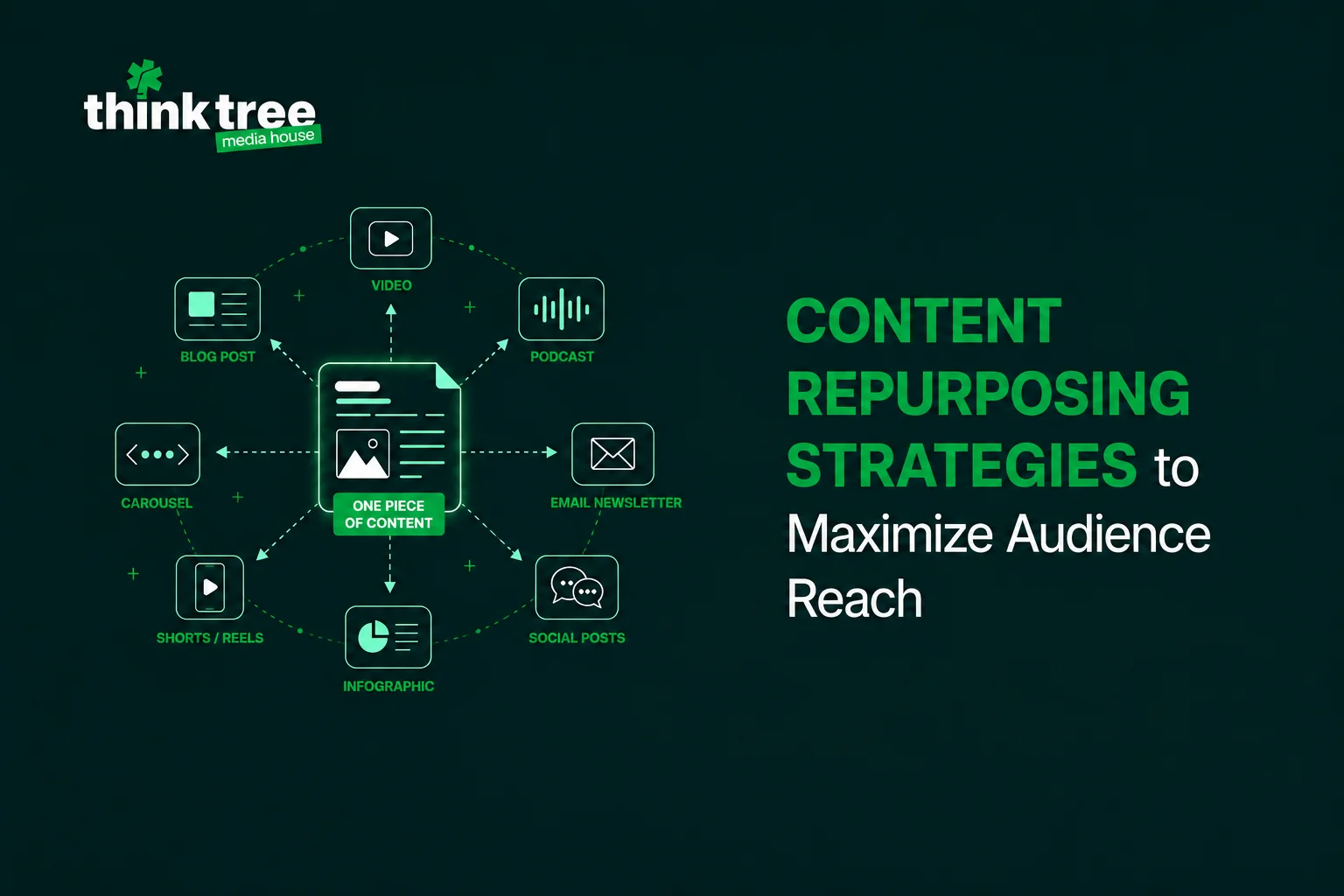
Struggling to stretch your marketing budget across twenty channels can feel exactly like attempting to book an auto in Indiranagar during a sudden evening downpour.
It requires immense patience, yields frequent cancellations, and leaves you completely drained.
Modern brands face an exhausting dilemma in a fast-moving corporate world. They are trapped on a content treadmill, constantly racing to write new blogs, script fresh videos, and design social media posts from scratch every day.
This rapid production schedule often leaves internal creative departments feeling burnt out. More importantly, it results in a massive library of high-quality assets that get buried under new uploads and are completely forgotten within weeks.
Whether you lead a growing business or direct marketing for a multinational enterprise, ignoring your existing creative archive is a massive waste of resources.
The key to sustainable digital growth does not involve working your creative team to exhaustion to satisfy demanding platform algorithms.
Instead, the solution lies in building a sophisticated framework that squeezes maximum value out of every single piece of media you produce.
This comprehensive guide will outline exactly how to transition away from linear production cycles by deploying an architectural approach to your creative library.
By implementing these advanced methodologies, you can scale your visibility, protect your creative sanity, and unlock unparalleled efficiency across your marketing ecosystem.
The Core Philosophy of Sustainable Production
Operating a modern brand requires deep operational efficiency.
If your creative department treats every single channel as an isolated island requiring separate brainstorms and distinct production timelines, you are bleeding valuable corporate leverage.
Breaking the Linear Content Cycle
Traditional creative models operate in a straight line.
A team conceptualizes an idea, drafts a piece of copy, publishes it to a specific platform, and immediately moves on to the next task.
This linear approach fails because it ignores the natural diversity of media-consumption habits within your target demographic.
Some prospective clients prefer reading analytical, long-form case studies on a desktop screen, while others engage exclusively with vertical video clips while scrolling through mobile applications during their daily commutes.
When you establish a comprehensive content strategy, you design your master assets with multi-format scaling in mind from the very first day.
You stop viewing a piece of media as a singular, static file.
Instead, you view it as a rich source of raw material that can be systematically disassembled and rebuilt for various environments.
This strategic shift transforms your creative department from a chaotic production house into an agile asset-optimization engine.
The Economics of Architectural Content Refinement
Investing heavily in premium production assets, such as high-end photography setups or detailed industry-research reports, only makes financial sense if those assets work hard across your entire digital footprint.
Deploying a structured approach to Content Repurposing maximizes your initial creative investment.
This approach drastically reduces your overall cost per asset while dramatically compounding your total digital impressions.
Instead of funding ten separate micro-campaigns throughout the fiscal quarter, your leadership team can allocate resources towards producing one incredibly deep, definitive master asset.
This asset then serves as the structural anchor for your entire quarterly marketing layout, ensuring your corporate messaging remains completely unified across every consumer touchpoint.
Auditing and Selecting Your Creative Foundations
Before your creative team can begin transforming existing assets, you must accurately identify which pieces of media possess the structural integrity required to support multi-channel expansion.
Executing a Comprehensive Asset Audit
To begin, your marketing department must conduct a thorough quantitative and qualitative review of your existing media archive.
Analyze historical performance metrics over the past twelve months to identify assets that generated high engagement, exceptional click-through rates, or strong lead-conversion metrics.
Look specifically for evergreen topics, which are themes that address permanent consumer pain points, core industry challenges, or timeless operational methodologies.
Avoid wasting energy on outdated seasonal promotions or passing industry trends that no longer hold market relevance.
Once you isolate your top-performing assets, organize them into a centralized digital registry.
This registry will serve as the foundation for your upcoming creative roadmap, helping you turn historical data into an actionable, highly structured content plan.
Transforming Master Assets into Multi-Channel Engines
The true magic of creative scaling occurs during the systematic deconstruction of a master asset.
Let us look at a practical example.
Suppose an organization produces a massive, authoritative text guide regarding corporate operational efficiency in the modern Indian workspace.
Deconstructing Long-Form Technical Assets
A comprehensive 5,000-word technical guide contains dozens of valuable micro-insights that are easily lost in a single reading session.
Transforming this extensive text into a dynamic format should feel as refreshing as catching that rare cool breeze on an April afternoon near Cubbon Park.
It provides instant clarity amid a chaotic environment.
Through structured content optimization, your editorial team can extract key statistics, core bullet points, and definitive industry frameworks from the text.
This extracted data can be transformed into separate, highly targeted educational pieces.
For instance, a single chapter within that master report can easily be adapted into a focused, conversational guest article for a premium B2B publication.
This strategy allows you to capture different segments of your target market without rewriting your fundamental value propositions.
This methodology forms the bedrock of a sophisticated content marketing strategy, ensuring your intellectual property reaches its full commercial potential.
Slicing Video Assets with Technical Foresight
Video assets provide an incredibly rich foundation for multi-channel scaling.
Consider a premium, two-hour panel discussion or a detailed product-demonstration video shot on an advanced system like the Canon EOS R8.
While the full-length video is exceptional for high-intent users on YouTube, it is far too long for casual discovery channels.
Your video-editing department can systematically slice that long-form master footage into multiple high-impact vertical video clips.
Focus on capturing sharp, thirty-second insights where a speaker answers a specific question or explains a complex technical variable.
By adding clean text overlays and high-contrast styling, you transform a singular video into a series of highly engaging clips designed to capture mobile scrollers.
If you need professional assistance in structuring these multi-format creative ecosystems, you can explore our digital marketing services to build a highly scalable visual presence.
Elevating Your Multi-Format Social Strategy
Every digital interface features its own distinct cultural nuances, technical specifications, and user-behavior patterns.
Directly copying a block of text from a website and pasting it onto a social timeline is a guaranteed recipe for poor user engagement.
Tailoring Graphics for Audience Context
To successfully land your message on highly competitive social feeds, you must translate your core insights into the native visual language of each platform.
For LinkedIn, this means converting your extracted data points into a sleek, multi-page PDF slide deck that users can swipe through natively.
This carousel format naturally increases user dwell time, signaling to platform algorithms that your material is exceptionally valuable.
For platforms like Instagram, the exact same data point can be paired with high-contrast, minimal graphic-design layouts that favor bold typography and clean whitespace.
Implementing this structured social media content strategy ensures that your brand looks completely native, sophisticated, and polished regardless of where a consumer encounters your business.
Master Asset Repurposing Framework
| Master Asset Component | Repurposed Format | Primary Target Channel |
| Statistical Research Data | High-Contrast Infographic | Pinterest and LinkedIn Feed |
| Executive Summary Section | Multi-Page PDF Carousel Document | LinkedIn Slide Deck |
| Expert Interview Footage | 30-Second Vertical Reel Clip | Instagram and YouTube Shorts |
| Case Study Chapter | Targeted Email Newsletter Layout | Direct Subscriber Inbox |
Modern Distribution Frameworks for Amplified Reach
Producing beautiful, multi-format variations of your creative material is only half the battle.
True market visibility requires a highly disciplined, automated approach to asset amplification.
Orchestrating Content Distribution
To maximize your market footprint, your team must establish a systematic approach to content distribution.
This process involves defining exactly when, where, and how frequently your repurposed assets are deployed across the web.
Instead of publishing all your multi-format variations simultaneously, space them out across several weeks.
For example, if your master article goes live on your corporate blog on Monday, your visual carousel can debut on LinkedIn the following week, and your vertical video insights can drop across short-form channels over the subsequent month.
This calculated distribution schedule ensures that a single creative concept maintains continuous market presence for an extended period, keeping your brand at the forefront of consumer awareness.
To streamline these complex distribution workflows, you can review our recommended marketing tools to discover software that automates daily publishing schedules.
Overcoming Content Decay and Algorithm Changes
Digital platforms consistently alter their organic-ranking algorithms, making reliance on a single distribution format highly risky.
When you consistently practice disciplined Content Repurposing, you insulate your organization against these unpredictable algorithm updates.
If a specific social platform reduces the organic reach of static images in favor of video, your team can adjust your deployment balance without restarting your entire creative pipeline.
Your master-asset registry remains intact, serving as a permanent foundation that can be repackaged to satisfy changing digital environments.
Frequently Asked Questions
1. Does content repurposing confuse or annoy audiences who follow us across multiple channels?
Not at all.
Consumers rarely see every single piece of media you publish across different platforms.
Furthermore, transforming your material into native formats ensures it looks completely fresh and contextual to the specific network where it lives.
2. How much time should pass before we repurpose an old blog post or video asset?
We recommend waiting at least three to six months before re-releasing a master asset in a completely new format.
This delay ensures your audience has ample breathing room, making the updated version feel highly relevant.
3. Can small internal marketing teams execute a comprehensive repurposing strategy successfully?
Absolutely.
By utilizing advanced automation software and template-based design workflows, a single corporate marketer can easily manage the deconstruction and distribution of a master asset without becoming overwhelmed.
4. Should we use automated translation software to localize our repurposed content?
While automated software is exceptional for basic translation drafting, you must always rely on human native editors to refine the local idioms, cultural nuances, and regional phrases for diverse markets.
5. What is the most critical metric to monitor when measuring repurposing success?
You should focus heavily on tracking your cumulative unique reach and overall lead-conversion rates across all adapted channels rather than monitoring superficial vanity metrics like total likes.
Conclusion
Transitioning away from the exhausting content treadmill is a mandatory step for any organization focused on long-term digital growth.
By embracing a disciplined, architectural approach to your creative library, you transform your intellectual property into a scalable corporate asset that consistently generates value.
From the precise deconstruction of long-form reports to the targeted execution of native social assets, every single creative adaptation must serve your broader commercial objectives.
This strategic framework allows you to dominate your industry, protect your creative energy, and build authentic connections with your market.
Are you ready to escape the chaotic content treadmill, grab a hot plate of idli-vada at an iconic local spot, and map out a bulletproof strategy customized perfectly for your business-expansion goals?
Contact our strategic planning team today to collaborate with our brand-growth consultants.
